Lebenslauf: 1-2 pages, reverse chronology, dates as MM/JJJJ, photo recommended, Ort, Datum and signature at the bottom; no parents or siblings.
Germany · Lebenslauf
Working in Germany: how to write a Lebenslauf and which documents you need
A Lebenslauf is the tabular CV a German employer expects: dates on the left, position and duties on the right, photo and personal data at the top, place, date and signature at the bottom.
- Format: Lebenslauf
- Language: German, English
- PDF and Word
In short
The package: Anschreiben (1 page, DIN 5008) → Lebenslauf → Zeugnisse (diploma, employment references and their translations).
Chancenkarte: at least 6 points, German A1 or English B2, degree listed in Anabin (H+) or a ZAB statement; nurses need B2 and degree recognition (Anerkennung).
Do you need a resume?
Yes
Fachkräfte visa / Chancenkarte
The employer selects directly: Anschreiben + Lebenslauf + Zeugnisse. With the Chancenkarte the employer in Germany still reads the Lebenslauf.
Yes
Pflege (nurses)
Lebenslauf + degree recognition (Anerkennung) + German B2. The intergovernmental programme runs through the Migration Agency; the employer makes the choice.
Yes
Seasonal work, HoReCa, Ausbildung
Even seasonal and restaurant jobs require a Lebenslauf in the German format and an Anschreiben (spot.uz, 25.09.2025).
Resume package
Online, right after payment, in the studio. A regular resume in the builder is free.
Chet elga
34 900 UZS
One-off payment for this resume, no subscription
- Lebenslauf - country format
- Translation into German or English (one language)
- AI proofreading, 8 templates, Word
- PDF right away, unlimited downloads
Chet elga+
49 900 UZS
One-off payment for this resume, no subscription
- Everything in «Chet elga»
- Cover letter drafted by AI, edited by you
- Both languages: German and English
Without payment: a regular PDF resume, the country format with a watermark.
In Germany the CV decides in almost every channel - the Fachkräfte visa, the Chancenkarte, the nursing programme, and even seasonal and restaurant jobs ask for «Lebenslauf + Anschreiben». Below: the Lebenslauf sections, the photo and the AGG rule, typical mistakes made by applicants from Uzbekistan, hiring channels, German levels, checking your degree through Anabin and ZAB, and a German-language sample for a nurse.
Lebenslauf format: the sections and what goes in them
A German CV opens with the word «Lebenslauf», then the name and photo, then the sections in a fixed order. Each section is a two-column table: period or row label on the left, content on the right. HR departments are used to this order - they look for the date on the left and the position on the right, and when the order is broken the document looks foreign.
| Section | What to write | Example |
|---|---|---|
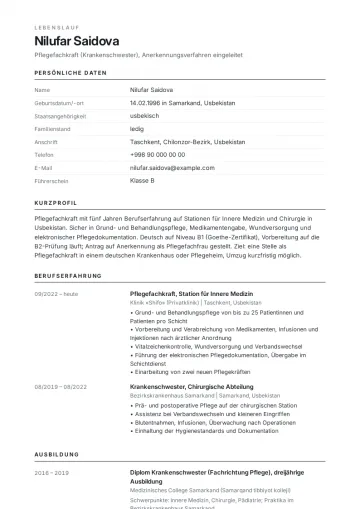
| Heading | The word «Lebenslauf», the name, photo top right | Lebenslauf - Nilufar Saidova |
| Persönliche Daten | Date and place of birth, nationality, address, phone, email; Familienstand optional; Führerschein | 14.02.1996 in Samarkand, usbekisch, ledig, Klasse B |
| Kurzprofil | 3-4 sentences: profession, years of experience, key skills, language level, goal | Pflegefachkraft mit fünf Jahren Erfahrung, Deutsch B1, B2 in Vorbereitung |
| Berufserfahrung | Reverse chronology: MM/JJJJ - MM/JJJJ, position, employer, city, 3-5 duties | 09/2022 - heute, Pflegefachkraft, Klinik «Shifo», Taschkent |
| Ausbildung | College or university, field, years; no school | 2016 - 2019, Medizinisches College Samarkand, Krankenschwester |
| Kenntnisse | Sprachen - CEFR level (A1-C2), EDV - software, Führerschein | Deutsch B1 (Goethe-Zertifikat), Russisch C1; MS Office |
| Zertifikate | Language certificate, further training - name, issuer, date | Goethe-Zertifikat B1, Goethe-Institut Taschkent |
| Ort, Datum, Unterschrift | City, date and signature - a scanned signature goes into the PDF | Taschkent, 05.09.2026 |
Length: one or two pages; with up to five years of experience one page is enough. Dates only as MM/JJJJ - 03/2026, with «heute» for the current job. Duties under each job start with a noun: «Durchführung der Grund- und Behandlungspflege», «Führung der Pflegedokumentation». Parents, siblings, ethnicity, religion - none of these belong in a Lebenslauf; those used to the Uzbek obyektivka form must remove exactly these rows.
Photo and personal data: what is mandatory and what is optional
Under the German equal-treatment rule (AGG) the photo is not mandatory - an employer may not demand it. In practice most applicants attach one and HR expects it. Date and place of birth and nationality are ordinary rows of Persönliche Daten. Marital status (Familienstand) is optional: often given in nursing and restaurant jobs, usually left out in IT. The address is written even if it is in Uzbekistan - the employer needs to know where the candidate will come from.
- Photo: 3×4 or slightly larger, light background, business dress, a light smile, taken in a studio - a phone selfie will not do.
- Nationality: «usbekisch» - citizenship, not ethnicity.
- Place of birth: city and country - «Samarkand, Usbekistan».
- Address: no street needed, district, city and country are enough; if you are in Germany - the German address.
- Phone in international format; no need to mention WhatsApp.
Typical mistakes made by applicants from Uzbekistan
- Obyektivka style: rows about parents, siblings, ethnicity, military rank - no place for them in a Lebenslauf.
- An English CV where German is required - a German Lebenslauf is expected.
- Date format 2026-03 or 03.2026 - in Germany it is 03/2026.
- No signature and date - to a German employer an unfinished document.
- Unexplained gaps in experience - HR asks about every empty month.
- Language level written as «good» - a CEFR level and the certificate name are needed.
- No Anschreiben, or one template for every employer - the letter is written per company.
- A word-for-word translation of the degree title - use the official name from Anabin.
- Sending a Europass - not expected in Germany, a plain Lebenslauf reads better.
How hiring for Germany works: the channels
The migration agreement between Uzbekistan and Germany was signed on 13.09.2024. In 2024, 800 nurses left, with salaries from 2,200 euros a month; the German side has requested 40,000 nurses, and a German Medical Academy has opened in Tashkent (gazeta.uz, 21.04.2026). In the Migration Agency's 12 «profession + language» projects half of the language-course costs are reimbursed. In every channel the employer selects the candidate by CV - only the visa differs.
Fachkräfte visa: an employer has been found
The main route for skilled specialists: a German company reads the Anschreiben, Lebenslauf and Zeugnisse, interviews, issues a contract, and the candidate applies for a visa at the German consulate. Here the CV is the centre of the package.
Chancenkarte: a visa for job seeking
The Chancenkarte lets you enter Germany without an employer and look for work there. Conditions: at least 6 points in the points system, German A1 or English B2, a degree listed in the Anabin database with the H+ mark or a ZAB Statement of Comparability (about 2 months), and proof of funds of 1,091 euros a month. In Germany the employer will still read the Lebenslauf and Anschreiben - so prepare them before leaving.
Nurses (Pflege): recognition and B2
Nursing is a regulated profession in Germany: to work, the degree is recognised by the authority of the federal state (Anerkennung) and German B2 is required. The Lebenslauf goes both into the recognition application and to the employer; it must describe the college programme, placements and wards precisely - that is exactly what the recognition authority compares. Recruitment under the intergovernmental programme runs through the Migration Agency, but the employer still picks the candidate by Lebenslauf.
Seasonal work, HoReCa and Ausbildung
Even a HoReCa employer like Europa-Park (German B1, age 18-40, 2,500 euros gross) requires a Lebenslauf in the German format and an Anschreiben (spot.uz, 25.09.2025). Ausbildung - the vocational training route - needs the same package plus the school certificate. There is no channel without a CV in Germany.
German language: which level is needed where
A1 is the minimum for the Chancenkarte (or English B2 instead). B1 - HoReCa and seasonal work, as in the Europa-Park example. B2 - nurses and other regulated professions. In the Lebenslauf the level is given by CEFR with the certificate name and date: «Deutsch B1 (Goethe-Zertifikat, 03/2026)». A level without a certificate will be tested at the interview. If the course is not finished yet, say so honestly: «B2 in Vorbereitung».
The Lebenslauf must be in German; for an English-language advert you send the English version, but the table structure stays the same - in the builder the de1 template works in both languages. The «Chet elga» package translates the Lebenslauf into German with AI; «Chet elga+» adds a draft Anschreiben (in DIN 5008 layout) and the English version. This is an AI translation, not a notarised one - the diploma and references need an official translation separately.
What to do with your degree: Anabin and ZAB
Anabin is the database of the German Conference of Education Ministers: if your institution is listed with the H+ mark and your field is in the list, the degree counts as recognised. If not, you request a Statement of Comparability from ZAB - about 2 months. For regulated professions - nurse, doctor - you additionally go through Anerkennung at the federal-state authority. The diploma, its transcript and employment references are submitted with an official translation; the institution name in the Lebenslauf must match the Anabin entry.
For comparison, see the 이력서 page - there too the employer chooses, but the form is built differently. Texts by profession are in the resume examples section; other destinations are in the Abroad section.
Document checklist
CV and documents
- Lebenslauf in German - 1-2 pages, photo, Ort, Datum and signature
- Anschreiben - 1 page, DIN 5008, separate for each employer
- Diploma with transcript, official translation institution name as in Anabin
- Employment references (Arbeitszeugnisse) with translation
- Passport valid for at least 6 more months
Language and certificates
- German certificate (Goethe, telc): A1 - Chancenkarte, B1 - HoReCa, B2 - Pflege
- Chancenkarte alternative - English B2 certificate
- In the Lebenslauf the level by CEFR with certificate name and date
Official steps
- Anabin check (H+) or ZAB Statement of Comparability - about 2 months
- Pflege: degree recognition by the federal-state authority (Anerkennung)
- Chancenkarte: 6 points and proof of funds of 1,091 euros a month
- Visa - German consulate; programme recruitment - Migration Agency
How to prepare a Lebenslauf in the builder
- 1
Fill in the resume in the builder in your own language: experience with duties, education, certificates, languages with CEFR levels.
- 2
Choose Germany as the country - the template switches to the Lebenslauf table and the form gains nationality, place of birth, marital status and Führerschein.
- 3
Upload a photo and fill in the rows; dates switch to MM/JJJJ and the Ort, Datum and signature block appears at the bottom.
- 4
Get the PDF or Word file in German; with «Chet elga+» also a draft Anschreiben.
Official channels
Make it in Germany
The German government's official portal on the Fachkräfte visa and the Chancenkarte
Anabin
Database for checking institutions and degrees (H+)
Auswärtiges Amt
German Federal Foreign Office: visa requirements
xorijdaish.uz
Official programmes of the Migration Agency, including the one for nurses
Jobs and official placement come only through these sources. Resum.uz does not offer vacancies.
Frequently asked questions
How do I write a German CV for a job in Germany?
As a Lebenslauf: the word «Lebenslauf» at the top, name and photo, then Persönliche Daten (date and place of birth, nationality, address), Kurzprofil, Berufserfahrung in reverse chronology, Ausbildung, Kenntnisse (languages by CEFR, EDV, Führerschein), Zertifikate, and Ort, Datum and signature at the bottom. Dates as MM/JJJJ, 1-2 pages, in German.
What is a Lebenslauf and how does it differ from a regular CV?
A Lebenslauf is the German CV: a table layout (dates on the left, content on the right), a personal-data block with date of birth and nationality, a photo, and place, date and signature at the bottom. Concrete duties instead of self-praise; no relatives.
Which documents are needed to work in Germany in 2026?
Lebenslauf and Anschreiben in German, the diploma with transcript and an official translation, an Anabin check or a ZAB statement, a language certificate (A1 to B2 depending on the channel), employment references, a passport valid for 6 more months. Nurses also file an Anerkennung application; the Chancenkarte requires proof of funds of 1,091 euros a month.
What do I need for the Chancenkarte?
At least 6 points in the points system, German A1 or English B2, a degree recognised in Anabin with the H+ mark or a ZAB statement, and proof of funds of 1,091 euros a month. The Chancenkarte lets you enter and look for work without an employer; in Germany the employer will still ask for a Lebenslauf and Anschreiben.
Which German level does a nurse need to work in Germany?
B2. Nursing is a regulated profession: the degree is recognised by the federal-state authority (Anerkennung) and a B2 certificate is required. The intergovernmental programme runs through the Migration Agency; 800 nurses left in 2024 and Germany has requested 40,000 (gazeta.uz, 21.04.2026).
Is a photo mandatory in a Lebenslauf?
Not under the AGG rule - an employer may not demand it. In practice most applicants attach one and HR expects it: a studio photo on a light background in business dress, top right. Selfies and cropped photos lower trust in the document.
Must the Lebenslauf be in German, and who does the translation?
For a German-language advert - in German; for an English one - the English version. In the «Chet elga» package the Lebenslauf text is translated with AI; this is not a notarised translation and does not work for the diploma or references. Show the result to someone who knows German.
Does Resum.uz place workers in Germany?
No. Resum.uz only prepares documents: it builds the Lebenslauf in the German format, translates it and delivers a PDF or Word file. Vacancies, the intergovernmental programme and visas go through the Migration Agency, licensed agencies and the German consulate.
Start with the resume
Country format, translation into its language and Word - online, right after payment. A regular resume in the builder is free.
Create a resume in the Lebenslauf formatUpdated: